Quick answer for buyers
For children's paper-stamping sets, water-based stamp ink may be preferred when easier cleaning matters. Certain oil-based formulations are selected for longer-lasting impressions, abrasion resistance or specific printing needs. Neither category guarantees sharper prints, safer use or better washability in every formulation.
At YIHUA, we recommend checking the actual stamp impression on the intended paper, the expected cleaning conditions and the complete stamp-and-ink configuration before approving a bulk order.
Choosing ink for a children's craft stamp set is not simply a question of selecting blue, pink or red. Buyers need a functional combination of stamp-face artwork, ink formulation, ink pad, intended paper and retail packaging.
Zhejiang Yihua Creative Technology Co., Ltd. draws on more than a decade of children's stamp manufacturing experience. This guide combines observations from our production work with practical questions buyers can use during sample approval.
1. What differs between water-based and oil-based stamp ink?
| Consideration | Water-based ink | Oil-based ink |
|---|---|---|
| Cleaning | In YIHUA's observations, commonly easier to clean under the conditions checked | Often more difficult to remove; cleaning depends on formulation |
| Paper impression | May show spreading or feathering on some absorbent papers | Some tested formulas gave well-defined edges; paper and formula still matter |
| Durability | Must be assessed for the intended application | Often considered where rubbing resistance or longer-lasting marks matter |
| Odor | Formulation-dependent | Some formulas have more noticeable odor |
| Typical projects | Paper-based children's creative activities and craft sets | Office and other durability-focused stamping uses |
These are practical tendencies, not universal rules. Different pigments, binders, additives, paper types and stamp-plate materials can change the result. Buyers should assess samples instead of ordering on the words “water-based” or “oil-based” alone.
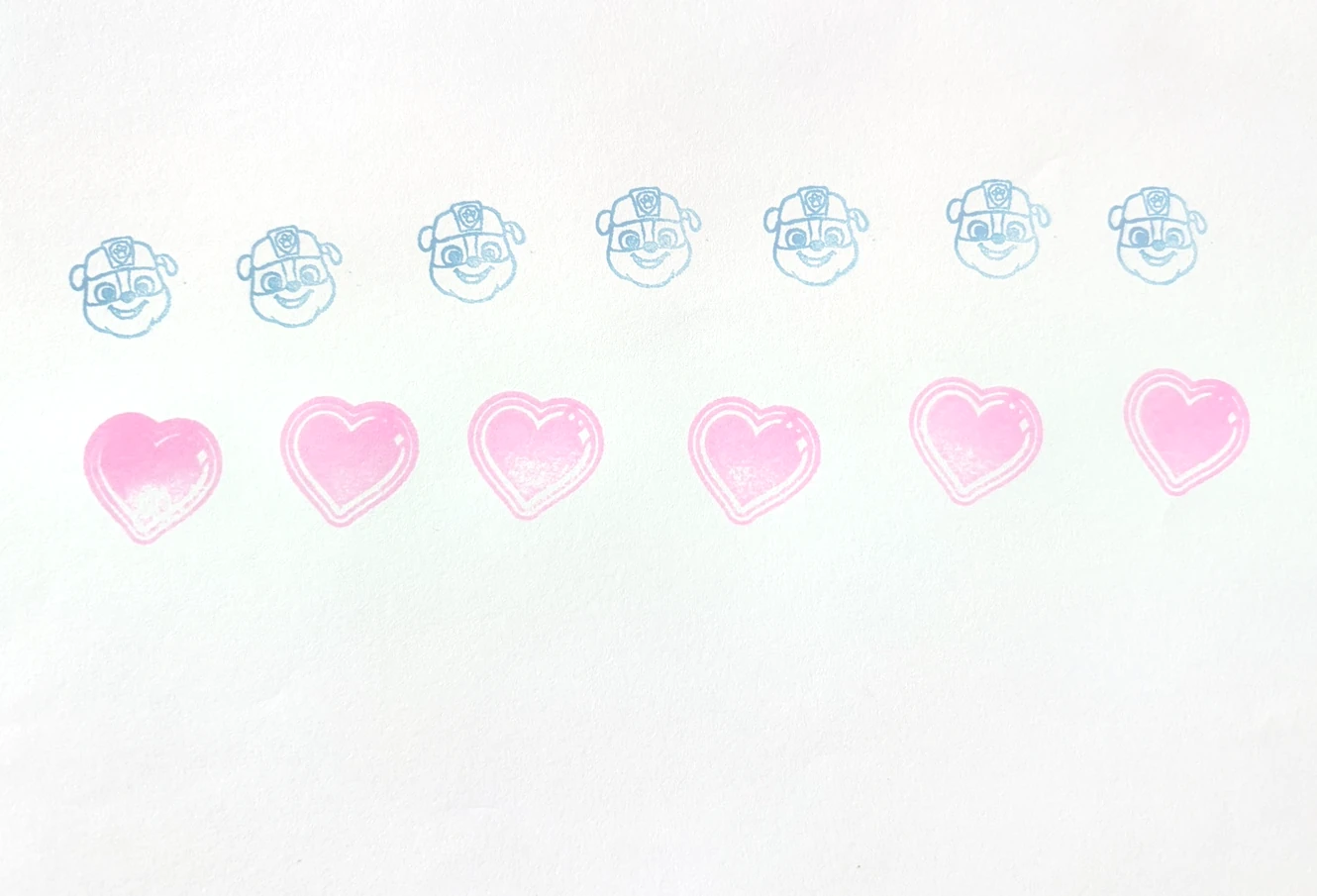
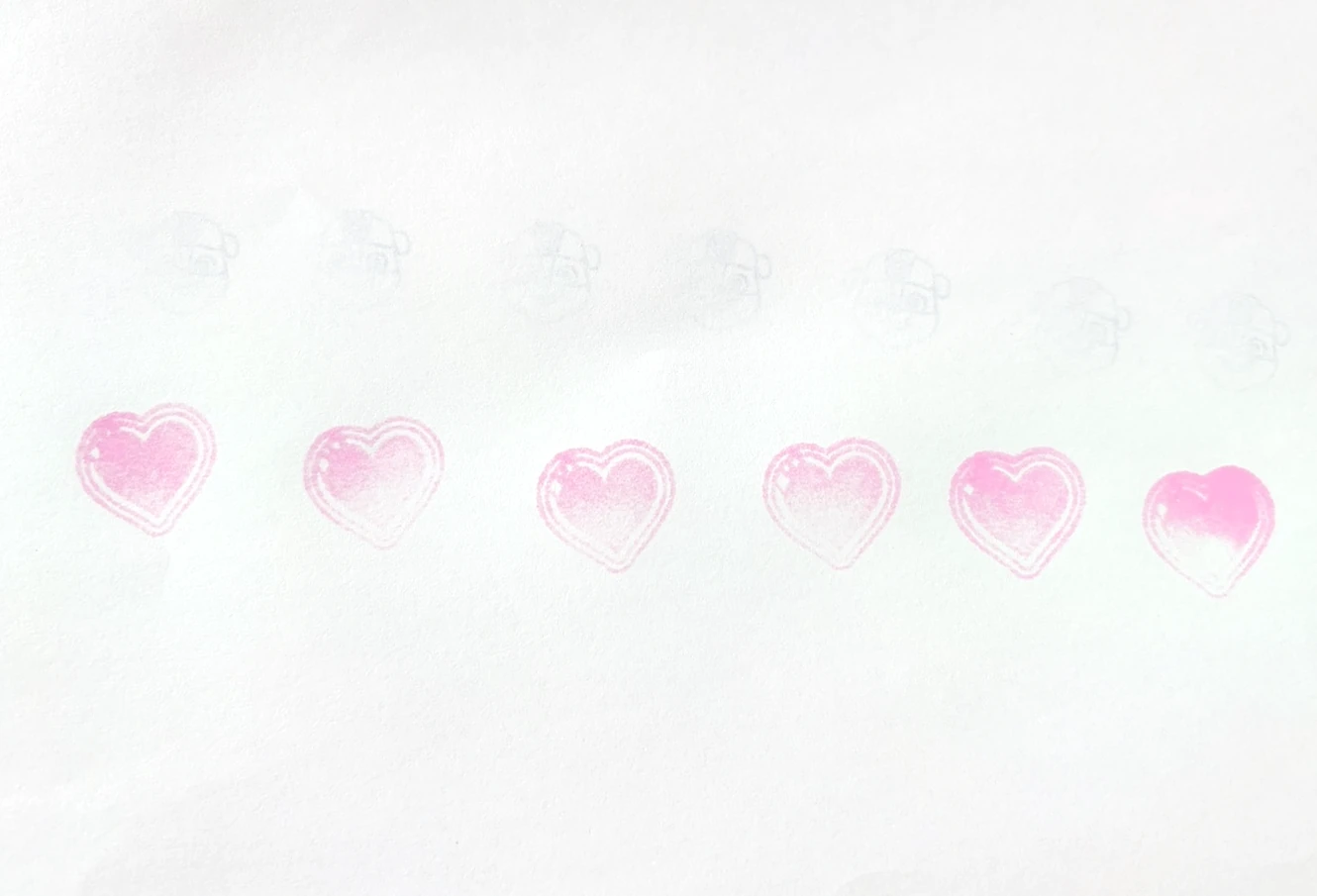
2. Original factory paper test: see the front and back
We photographed a sheet of ordinary paper after stamping with two different inks: pink heart impressions were made with water-based ink, while blue illustrated impressions were made with oil-based ink.
These images are genuine factory observations, not computer-generated impressions. We have only corrected the orientation and overall lighting of the photographs. In particular, the reverse-side show-through is kept faint rather than artificially intensified.
3. What does washable mean for a children's ink pad?
YIHUA's practical cleaning observations show that its tested water-based ink was comparatively easy to remove; in one cotton-fabric trial, the mark washed away readily. The result relates to the particular formulation and materials tested, not every fabric or every commercial stamp ink.
For overseas buyers, it is useful to define the cleaning requirement before requesting samples. Should accidental ink marks be removed from cotton, skin after unintended contact, plastic, or another material? Must removal work with water alone? Are soap and a particular washing process acceptable?
Washability does not mean that the ink is designed for stamping on skin. The water-based ink described here is intended for paper-stamping applications, not intentional body stamping. Similarly, the fact that a particular oil-based ink adheres well to skin does not establish that it is safe for intentional skin use.
Are food-grade colorants the same as a certified child-safe ink?
No. Some of YIHUA's water-based formulations use colorants described as food-grade. A colorant is only one part of the formulation. This description alone does not mean that a finished ink is edible, approved for skin stamping or compliant with every toy and art-material requirement.
Testing and labeling depend on the finished product, age category, intended use and destination market. For US projects, buyers may need to evaluate the applicable toy standard and art-material labeling obligations, including ASTM D-4236 where relevant. See the US Consumer Product Safety Commission's labeling overview for general guidance.
4. Why fine stamp artwork needs spacing: YIHUA's 0.4 mm reference
A customer may send a beautiful cartoon illustration or alphabet design with very fine details. But a digital drawing does not automatically become a readable stamp impression once it is reduced to a small plate.
YIHUA generally recommends starting with about 0.4 mm of spacing between adjacent lines when reviewing small detailed stamp designs. This is a factory screening reference, not an international standard or a guaranteed minimum for every material.
Small facial features, crowded lettering and narrow gaps can merge when stamped. Artwork may need simplifying, enlarging or adjusting before plate production. The final result also depends on impression size, plate construction, ink, paper and stamping pressure.
What buyers should approve: a real printed impression from the proposed stamp face, not simply the artwork on a monitor or a decorated product cap.
5. A practical OEM sample-approval checklist
| Check | What the buyer should confirm |
|---|---|
| Artwork and fine lines | Are numbers, letters and narrow details recognizable on the real impression? |
| Ink and stamp compatibility | Does the chosen stamp face receive and transfer ink consistently? |
| Paper | Is the test carried out on the paper supplied in the activity kit or expected in normal use? |
| Cleaning | Which exact surfaces and washing conditions are included in any washability claim? |
| Ink-pad storage | Has the proposed pad closure and retail packaging been assessed for the intended storage conditions? |
| Final retail assortment | Do the ink colors, stamp designs, quantities and printed packaging match the approved sample? |
These are recommended procurement checkpoints. Project-specific acceptance criteria and relevant product testing should be agreed before production.
6. Factory experience: developing multiple 26-piece retail stamp sets
The 26-piece children's stamp set has been a repeat retail format in YIHUA's manufacturing experience over more than ten years. Supermarket and other retail customers have commissioned collections built around different themes.
Rather than restricting a collection to a single artwork version, customers may keep a similar packaging structure while changing the 26 stamp impressions, color assortment and printed outer box. This gives shoppers multiple coordinated choices and can simplify the development discussion compared with designing every pack structure from scratch.
For projects with several versions, we recommend a simple written matrix: version code → 26 artwork designs → ink colors → printed packaging → approved reference sample. Check this list against actual samples and complete packed sets. This is a practical recommendation for preventing assortment mix-ups, not a claim that every retailer uses an identical inspection system.
For more on packaging and multi-theme retail collections, read our custom seasonal stamp-set guide.
7. What should you send a stamp manufacturer for a quote?
For an accurate OEM review, it helps to send the intended stamp-face artwork or reference picture, approximate stamp size, number of designs, required ink colors, expected purchase quantity, destination market and preferred retail packaging.
If you need special cleaning performance or a particular impression quality on your own paper stock, specify that at the beginning. Buyers developing several 26-piece collections should also identify how the artwork and packaging versions differ.
YIHUA can review suitable existing stamp-body molds, custom impression artwork, available ink arrangements, sample requirements and retail packaging for the proposed project. Final price, development fees, MOQ, test documentation and schedule are confirmed for the actual configuration.
Planning a Custom Kids' Stamp Set?
Send us your stamp artwork, preferred ink type, number of designs, expected quantity and packaging concept. We will review possible OEM options and discuss samples.
Discuss Your Stamp ProjectEmail lucy@yihuaart.cn · WhatsApp Lucy