An OEM sourcing guide for children's art brands, importers and stationery buyers.
Custom shaped crayons give children's art brands a way to create products beyond conventional stick crayons. Whether your collection features animals, fruits, characters or promotional themes, working with a custom shaped crayon manufacturer involves more than choosing an attractive design.
For overseas buyers, the questions are practical: Can the shape be manufactured consistently? Do you need a new mold? What is the minimum order quantity (MOQ)? When can samples and finished goods be ready?
At Zhejiang Yihua Creative Technology Co., Ltd. (YIHUA) in Lanxi, China, we manufacture injection-molded shaped crayons and develop custom molds, color assortments and retail packaging. Here is how a project moves from a reference picture to bulk production.
1. Start with Your Product Idea
You do not need a completed 3D drawing to start. Many buyers first contact us with a product photograph, character illustration, hand sketch or physical sample. We review the reference before deciding whether an existing mold will work or a new one is required.
To help us evaluate your project, please share:
- Design: A picture, sketch, sample or 3D model, if available.
- Size: Approximate length, width and thickness.
- Colors: Number of pieces and colors per set; preferred shades.
- Market: Destination country and any retailer-specific requirements.
- Quantity: Estimated order volume, such as 3,000 or 5,000 sets.
- Packaging: Existing YIHUA box, custom printed box, tray or gift set.
- Timing: Desired delivery or retail-launch date.
For licensed characters or brand artwork, buyers should ensure they have the necessary design rights. Starting with a clear brief helps prevent unnecessary mold revisions later.
2. Existing Crayon Molds vs. New Custom Molds
Option A: Use an Existing Mold
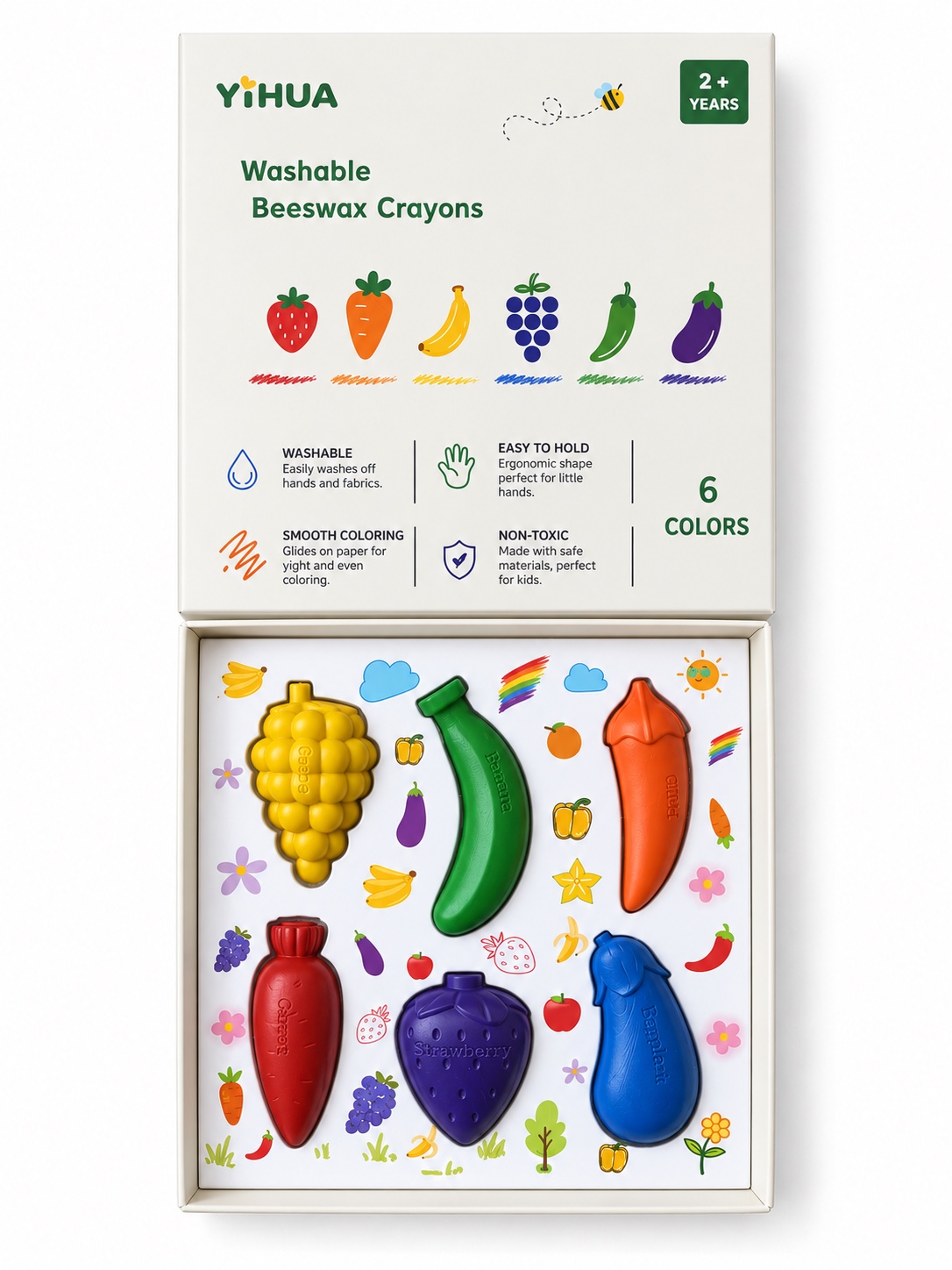
YIHUA has existing fruit-and-vegetable crayon molds and animal crayon molds. Our six-fruit collection includes banana, strawberry, eggplant, grape, chili pepper and carrot shapes. Buyers can discuss colors, formulas and packaging without paying to develop those shapes from scratch.
An important production detail: our standard six-fruit mold forms multiple different shapes together, so the color assigned to each shape can vary in standard production. If a retailer needs every box to contain the same shape-to-color combination, tell us before production; another mold or production arrangement may be needed.
Existing molds are often the better choice when you want to test a new category, control tooling investment or launch sooner.
Option B: Develop a Completely New Shape
New tooling makes sense when you need an exclusive character, logo-inspired shape, themed collection or a different product structure. We evaluate the proposed dimensions, fine details, undercuts, mold release and the strength of narrow sections.
A drawing may need small adjustments before it becomes a practical crayon. That is why design feasibility comes before the final tooling quotation.
3. MOQ: How Many Sets Must You Order?
Different purchasing routes have different minimums. The references below describe YIHUA's current six-fruit product and typical custom arrangements; they are not universal MOQ promises for every design.
| Order route | Reference minimum | Best suited for |
|---|---|---|
| Existing boxed six-color fruit crayons, subject to stock | 1 carton / 48 boxes | Small trial orders using available packaging |
| Existing shapes with custom colors or branded boxes | Usually 3,000 sets | Private-label retail collections |
| A completely new custom-shaped crayon mold | Project-specific quotation | Exclusive characters and new structures |
The MOQ for a new mold depends on shape complexity, number of cavities, material usage and the production arrangement. Packaging, color changes and inspection requirements can also affect economic batch size.
For small orders, ask us about available stock first. For a new design, share your target volume early so we can evaluate a realistic tooling and production plan.
4. From Artwork to Bulk Production: Six Stages
Stage 1 — Design review. You send the image or product brief, size, set configuration, market and quantity. We assess manufacturability and discuss existing molds versus new tooling.
Stage 2 — Mold proposal and quotation. For a new shape, we review mold structure, cavities, engraving, likely modifications and tooling costs. Mold charges and unit prices are quoted separately.
Stage 3 — Mold manufacturing. After the tooling plan and design are approved, mold production begins. A conventional new crayon mold may take around 25 days, depending on complexity.
Stage 4 — Trial molding and samples. Once the required tooling or production arrangement is ready, sampling generally takes around 7–15 days. We check molded appearance, color and drawing performance. Additional adjustments can extend this stage for complicated new designs.
Stage 5 — Buyer approval. You review the physical samples, shape details, drawing feel, color selection, packaging and relevant test documentation before confirming the production specification.
Stage 6 — Bulk manufacturing and packing. We prepare materials, mold the crayons, inspect them and complete the agreed packaging. Production and shipment are scheduled around the approved order and specification.
5. What Timeline Should a Buyer Plan For?
| Activity | YIHUA planning reference |
|---|---|
| Dispatch of confirmed ready stock | Approximately 1 week |
| Conventional new crayon mold development | Approximately 25 days |
| Sample preparation after tooling or setup is ready | Approximately 7–15 days |
| Custom boxed production using existing tooling | Approximately 25 days after approvals, depending on the order |
| New design, bulk production and shipment | Quoted after feasibility and sample approval |
These stages do not all happen at the same time. A completely new character must pass through mold making and sample approval before the final bulk-production schedule can be confirmed. Revisions, laboratory testing, transport and seasonal production demand can affect the total calendar time.
If you have a fixed launch deadline, tell us at the beginning. We can then discuss which steps are realistic rather than promising a delivery date before the design is approved.
6. What Determines the Custom Mold Cost?
Mold fees are driven by engineering and tooling requirements, not just the number of crayons in a box. The main factors include:
- Design complexity: Detailed characters, projections and difficult release angles.
- Size and construction: Larger products or unusual structures may need different tooling.
- Number of cavities: Mold layout affects both the upfront cost and production capacity.
- Engraving and surface finish: Fine textures, lettering and decorative features take machining work.
- Revisions: Design changes after approval may require additional engineering.
We review these points against the actual drawing before quoting. Buyers should also clarify what the tooling fee covers, whether revisions are included and whether the mold is reserved for their exclusive use.
7. Samples, Drawing Quality and EN71 Reports
A custom shape should not only look attractive in a photograph. Physical samples let you evaluate smooth coloring, color coverage, surface finish, grip, narrow features and protection inside the retail package.
YIHUA uses the same base raw-material formulation across our standard injection-molded shaped crayons and has EN71 test reports relating to these materials and products. We can share the relevant available reports with buyers for review. If a project changes the formulation, adds components or has special destination-market requirements, we confirm which documentation or additional tests are applicable to the final specification.
Please tell us your target sales market before placing an order so we can discuss the appropriate compliance documents and testing requirements.
8. Request a Sample or Discuss Your Project
You can begin with a single reference photo. Send us your preferred shape, approximate dimensions, color count, expected order quantity, market and packaging concept. We will discuss existing molds versus new tooling, the likely MOQ, the 7–15-day sampling reference, and a practical quotation and production schedule.
Request a Sample / Discuss Your Project
Email: lucy@yihuaart.cn
WhatsApp: +86 180 6764 4687
Manufacturer: Zhejiang Yihua Creative Technology Co., Ltd., Lanxi, Zhejiang, China.
All quantities and timelines are planning references; final terms are confirmed after product review and sample approval.